Online Poker Guide: How to Play Poker Online and Choose the Best Offer

Poker is a skill game. That single fact changes everything about how you approach it online.

Whether you are completely new to cards or shifting from casual home games, this guide covers every essential step. Hand rankings, game mechanics, platform safety, bankroll math, your first strategy — it is all here. The goal is simple: help you make informed decisions before you sit down at any table, free or real money.

"Over the last eight years of reviewing regulatory frameworks and market approaches, our main conclusion is that understanding the core mechanics of a game is the only path to playing responsibly. A sports-first mindset means prioritizing strategy, transparency, and safety over the pursuit of quick profits." — Nadiya Farzana Haq, iGaming Bangladesh.

What poker is and how online poker works. Poker is a peer-to-peer card game built on strategy, incomplete information, and statistical probability. You compete against other people — not the house. On

What poker is and how online poker works

Poker is a peer-to-peer card game built on strategy, incomplete information, and statistical probability. You compete against other people — not the house. Online poker replicates this inside a digital environment, replacing human dealers with encrypted software and a Random Number Generator (RNG).

The virtual format speeds things up considerably. A physical casino deals roughly 20 to 30 hands per hour. Playing at digital poker tables? Expect 60 to 100 hands per hour, according to data reviewed in "Sitting at the Virtual Poker Table Ten Years Later" — UNLV Gaming Research (2023). https://digitalscholarship.unlv.edu. The platform handles chip distributions and pot calculations automatically, which means you face more strategic decisions per session. With disciplined play, that accelerated pace genuinely speeds up skill acquisition.

Here is the part that matters most: your long-term outcome depends heavily on skill, not pure chance. A comprehensive longitudinal study tracking 91,439 poker players across roughly 85 million hands over 40 months confirmed this. Players who concentrated bets on hands with high expected value and acted more aggressively with strong holdings demonstrated significantly better results — von Roten et al., "The dominance of skill in online poker", IDEAS/RePEc, ETH Zurich (2023). https://ideas.repec.org.

In an online poker game, the operator merely acts as a facilitator, collecting a minor service fee called the rake. Your primary obstacle? The intellect of other poker players navigating the same mechanics you are.

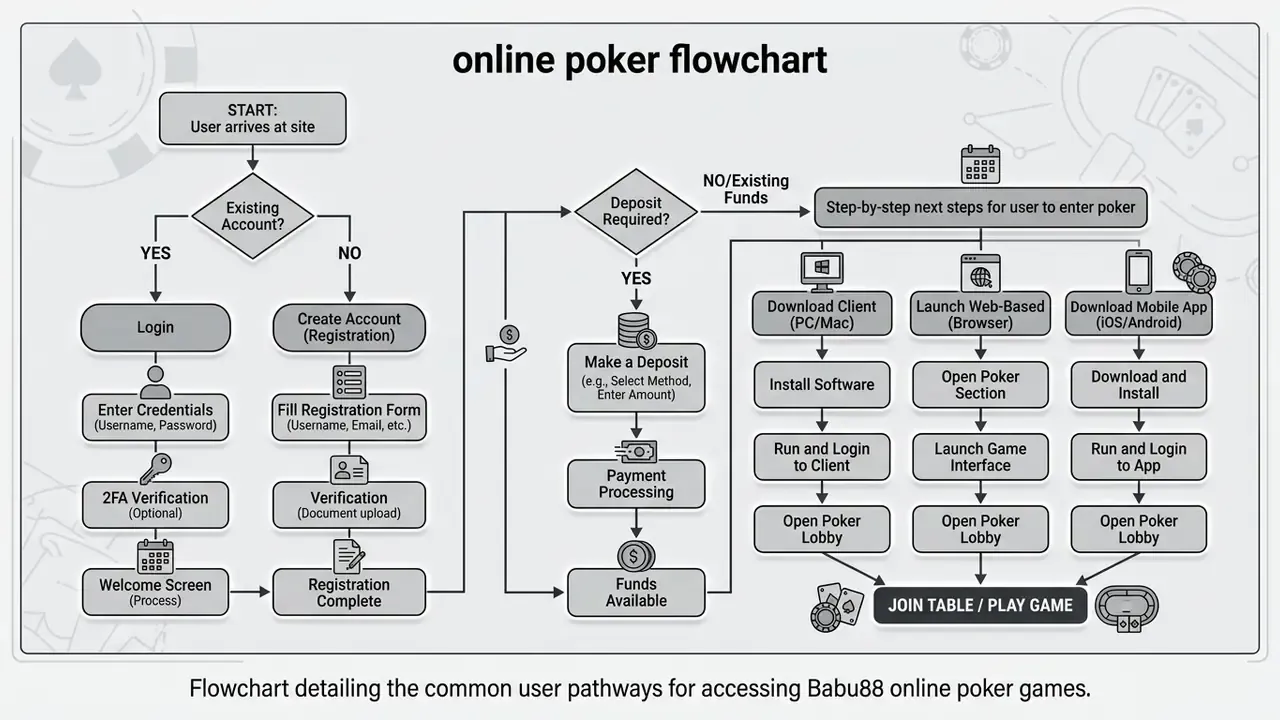
How a poker game starts online. Getting into an online poker game requires a few straightforward steps: register an account, verify your identity, select an appropriate table limit, and receive your s

How a poker game starts online

Getting into an online poker game requires a few straightforward steps: register an account, verify your identity, select an appropriate table limit, and receive your starting cards automatically. Modern platforms mandate standard "Know Your Customer" (KYC) identity checks — a compliance step that filters out fraudulent activity and keeps the environment safer for everyone.

After authentication, you log into the lobby via a web browser or downloaded client. Modern HTML5 poker rooms use WebGL for rendering and WebSockets (RFC 6455) for real-time data transmission. That means you can often play poker without downloading any software at all.

Though, to be fair, native desktop clients generally offer better graphical latency and fewer disconnects.

Once inside, you browse available stakes — from micro-limits to high-tier tables — and select an open seat. The RNG mechanism shuffles the virtual deck using complex encryption (typically AES-256). Within two to five seconds of the next round starting, the server distributes your hole cards. Every piece of the process is engineered for a frictionless, rapid start without compromising data security or fairness.

Online poker vs poker casino format. This distinction is fundamental. Online poker pits you directly against human opponents. Poker casino formats match you against the house with predetermined mathem

Online poker vs poker casino format

This distinction is fundamental. Online poker pits you directly against human opponents. Poker casino formats match you against the house with predetermined mathematical odds.

In standard player-versus-player environments, success comes from outplaying individuals. The money redistributes between participants, so a highly strategic player can generate a positive expected return by exploiting human errors — the von Roten et al. (2023) study confirmed this dynamic across tens of millions of hands. Conversely, house-banked games such as Casino Hold'em and other casino formats or video poker rely on fixed paytables.

In video poker, for instance, the outcome is entirely you versus the machine. No bluffing, no reads — pure mathematics against a published Return-to-Player (RTP) percentage.

In casino poker variants, the establishment maintains a permanent structural advantage, similar to a roulette wheel. The element of skill shrinks dramatically, and the concept of beating the game long-term essentially vanishes.

Recognizing this separation shapes your entire gaming journey.

User flow from format choice to the first hand
  1. Choose your access method: Decide between a mobile app or a browser connection.
  2. Complete documentation: Register and provide verification to meet compliance requirements.
  3. Determine your format: Separate peer-to-peer tables from fixed-odds casino alternatives.
  4. Scope the lobby: Filter available tables by specific financial limits.
  5. Play poker now: Claim an empty seat and wait seconds for the automated deal to begin.

Poker hand rankings every player must know

Before sitting at any table — free or real money — you need to memorize the ten standard poker hand rankings. Without this knowledge, you simply cannot evaluate whether to bet, call, or fold. Every poker variant discussed in this guide uses this hierarchy, from strongest to weakest:

RankHandExampleDescription
1Royal FlushA♠ K♠ Q♠ J♠ 10♠Ten through Ace, all of the same suit. The rarest and strongest hand possible.
2Straight Flush8♦ 7♦ 6♦ 5♦ 4♦Five consecutive cards of the same suit.
3Four of a KindA♠ A♥ A♦ A♣ 6♠Four cards of identical rank plus any kicker.
4Full HouseK♠ K♥ K♣ Q♦ Q♥Three of one rank paired with two of another.
5FlushA♠ K♠ J♠ 5♠ 3♠Any five cards of the same suit, regardless of sequence.
6Straight5♥ 4♥ 3♦ 2♠ A♣Five consecutive cards across mixed suits.
7Three of a Kind7♠ 7♣ 7♦ A♥ 2♣Three cards of the same rank.
8Two Pair5♠ 5♣ 4♣ 4♥ J♣Two distinct pairs plus one kicker.
9One Pair9♠ 9♣ A♥ 8♦ 2♣A single matched pair with three kickers.
10High CardA♥ Q♠ 7♥ 5♠ 3♠When none of the above applies, the highest individual card decides.

If two players hold the same ranking hand at showdown, the highest kicker breaks the tie. On rare occasions when hand strengths are completely identical — kickers included — the pot is split evenly. That is called a chopped pot. Commit this table to memory. It is the single most referenced piece of knowledge at every poker table in the world.

Which poker games online are most common. The most widespread poker games online feature Texas Hold'em and Omaha, divided into continuous cash tables and scheduled tournament formats. Picking the righ

Which poker games online are most common

The most widespread poker games online feature Texas Hold'em and Omaha, divided into continuous cash tables and scheduled tournament formats. Picking the right variant matters more than most beginners realize.

According to the 2024 Fortune Business Insights report, active cash games command approximately 47% of the global market share — largely because they offer unmatched flexibility — Fortune Business Insights, Online Poker Market Report (2024). https://www.fortunebusinessinsights.com. Players appreciate the ability to join and disconnect instantly without sacrificing accumulated chips. Tournaments constitute the other massive segment, drawing participants through competitive leaderboard narratives and the appeal of outsized payouts.

Texas Hold'em and Omaha for new players. Texas Hold'em is universally recognized as the optimal starting point for new poker players. The reason is structural: it uses a straightforward two-card start

Texas Hold'em and Omaha for new players

Texas Hold'em is universally recognized as the optimal starting point for new poker players. The reason is structural: it uses a straightforward two-card starting hand logic. You combine your two private cards with up to five community cards. The number of possible hole-card combinations is exactly one pair, making equity calculations manageable even for beginners.

Omaha shifts the picture dramatically. Players receive four private cards but must use exactly two to form a hand. Because the number of possible two-card selections from a four-card hand is six — compared to one in Hold'em — the mathematical combinations explode.

This inflates wrap draws and causes board textures to change aggressively. New poker players frequently overvalue their holdings in Omaha. That is a costly habit.

Focusing on basic Texas Hold'em rules builds the discipline needed before exploring higher-variance variants. Start simple. The complexity will find you soon enough.

Other variants: Stud, Razz, and Casino Poker. While Hold'em and Omaha dominate online traffic, several other poker disciplines maintain dedicated player pools:

Other variants: Stud, Razz, and Casino Poker

While Hold'em and Omaha dominate online traffic, several other poker disciplines maintain dedicated player pools:

  • 7-Card Stud:No community cards at all. Each player receives a mix of face-up and face-down cards across multiple betting streets. It demands strong memory and card-tracking skills, because visible cards directly inform probabilities.
  • Razz:A lowball variant of 7-Card Stud where the lowest hand wins. Ace-to-Five is the best possible holding. Niche, but popular among veteran players seeking variety.
  • 3-Card Poker:A casino-banked game where each player and the dealer receive only three cards. Straights beat flushes because three-card flushes are statistically easier to make. This is a house-edge game — no player-versus-player component.
  • Video Poker:Entirely you versus the machine. No bluffing, no opponent psychology — only optimal mathematical selection against a published paytable. Video poker appeals to players who enjoy pure probability without the social element.

Understanding these variants helps you recognize which games are skill-based PvP formats and which carry a built-in house advantage. That distinction is worth keeping front of mind.

Cash tables, tournaments, and live formats. Cash tables offer immediate financial translation — chips hold direct monetary value. Tournaments operate on a defined entry fee and play until completion.

Cash tables, tournaments, and live formats

Cash tables offer immediate financial translation — chips hold direct monetary value. Tournaments operate on a defined entry fee and play until completion. Live variants introduce a streaming dealer for a more social experience.

An online poker game structured as a cash table lets you top up or leave seamlessly. Tournaments, on the other hand, charge a strict buy-in at the start. They generate highly skewed outcome variance: most entrants leave empty-handed while a tiny percentage wins substantial amounts. Observational econometric analysis confirms that many players systematically choose lottery-like payout formats, accepting negative expected value for a shot at outsized returns — Observational econometric study on skewness preferences in online poker, ScienceDirect (2024). https://www.sciencedirect.com.

We saw a telling example during a local Bangladesh sports community test regarding game types. Players continually lost funds chasing massive tournament payouts without proper strategy.

We guided them toward micro-stakes cash formats instead. The result? Their bankroll longevity improved considerably. Slow-paced cash tables permitted focused learning without the sudden risk of tournament elimination. Live dealer setups combine digital betting with visible human interaction, though they generally lean towards casino-style formats with a fixed house edge.

Format VariantLevel of Entry for New PlayersSpeed / TempoType of Experience
Texas Hold'em CashMedium (Requires basic math)Fast (60–100 hands per hour)Continuous play, immediate drop in/out
Multi-Table TournamentsLow (Defined initial cost)Slower (Structured progressive rounds)Prolonged sessions, skewed payout events
Pot-Limit Omaha CashHigh (Complex combinatorics)Fast (Potentially higher variance)High-action, aggressive draws, volatile swings
Sit & Go TournamentsLow–Medium (Fixed buy-in, small field)Moderate (Fills then begins)Short sessions, fast feedback loop
Live Dealer Casino PokerLow (House-banked limits)Moderate (Dependent on live video feed)Entertainment focus, built-in fixed edge
Video PokerLow (Solo, no opponents)Self-pacedPure math vs. machine, no social element
Free online poker or real money: what the difference means for you. The core distinction is straightforward. Playing poker online free eliminates financial stress so you can focus on mechanics. Real m

Free online poker or real money: what the difference means for you

The core distinction is straightforward. Playing poker online free eliminates financial stress so you can focus on mechanics. Real money play introduces tangible consequences that radically alter how opponents behave — and how you should respond.

If your goal is recreation, free chips provide endless entertainment without pressure. However, behavioral psychology and operator data confirm that removing financial risk changes the game's integrity. In free-play environments, re-buying virtual chips requires just a click or two, which diminishes the emotional weight of losses and can encourage impulsive patterns — Ring, L., "Poker for Nothing and Chips for Free", PhD dissertation, University of Georgia (2018). https://esploro.libs.uga.edu.

Understanding your objective — whether it centers on practicing a new hobby safely or engaging in genuine, calculated competition — clarifies which path suits your mindset.

When free poker online is the better choice. Free poker online is the superior choice when you are memorizing hand rankings, testing software stability, and adjusting to automated timer countdowns. Na

When free poker online is the better choice

Free poker online is the superior choice when you are memorizing hand rankings, testing software stability, and adjusting to automated timer countdowns. Navigating an online poker game lobby for the first time requires patience. Misclicking a bet slider or misreading the big blinds can devastate a beginner playing with real cash.

A demo environment operates as an educational shield. You use virtual money to explore different poker games online. Play-money mode lets new players learn the software interface without financial stress, practice time-bank mechanics repeatedly, and internalize the hand-ranking hierarchy from the table above. Once you feel perfectly synchronized with the digital actions, you can comfortably graduate from this phase.

When real money poker offers more value. Real money engagement provides better value when you intend to deploy competitive mathematical strategies, test your skills against serious poker players, and

When real money poker offers more value

Real money engagement provides better value when you intend to deploy competitive mathematical strategies, test your skills against serious poker players, and unlock specific promotional enhancements.

The behavioral shift is significant. On real-money tables, opponents face direct monetary loss, so their decision-making tightens. Ranges narrow, bluffs become more targeted, and the overall quality of poker play rises compared to free-chip environments. Furthermore, loyalty bonuses and chip rakeback features become mathematical assets when properly calculated. Rakeback commonly ranges from single digits to about 40% of rake paid in modern online poker ecosystems, directly boosting your effective win rate.

One important caution: among young men specifically, regular participation in online gambling — including card games — is associated with higher rates of problem gambling behavior — Ioannidis et al., "Online gambling among young men", Wiley (2023). https://onlinelibrary.wiley.com. This finding reinforces the need for self-imposed limits before engaging in real-money play.

RESPONSIBLE GAMING ALERT: Real money poker demands strict self-control and is entirely unsuitable if you are pursuing guaranteed income. All bonuses carry specific wagering conditions restricting immediate withdrawals. Always review your local jurisdictional limitations, set non-negotiable deposit boundaries, and never gamble with capital you cannot afford to comfortably lose. If you are in Bangladesh, note that popular e-wallet services (bKash, Nagad, Rocket) may be used for platform deposits where supported — but always verify that the platform accepts your payment method and operates within your region's legal framework before committing funds.

Disclaimer: The information in this guide is general in nature and does not replace professional advice. Online poker for real money is a form of gambling. Before you begin, review the gambling legislation of your jurisdiction. If you suspect you may have a gambling problem, contact a local support service immediately.

How to choose the best online poker site or room. Finding the best online poker site means verifying international licensing, checking mobile-friendly interfaces, reviewing the clarity of gaming softw

How to choose the best online poker site or room

Finding the best online poker site means verifying international licensing, checking mobile-friendly interfaces, reviewing the clarity of gaming software, and confirming dense player traffic. Avoid aggressively marketed platforms lacking transparent regulatory footers.

Unlicensed or weakly regulated sites carry elevated risks of unfair practices, delayed payouts, and absence of responsible gaming tools — Spectrum Gaming Group, Indiana Gaming Commission Market & Policy Analysis (2023). https://www.in.gov/igc. A reputable room undergoes frequent software testing by independent auditors. Playing poker must also feel seamless across devices. A robust mobile framework prevents connectivity drops during crucial hands. Selecting reliable sites shields you from predatory practices and ensures that withdrawals occur smoothly within standard timeframes.

What new players should check before they play. Before processing any deposits, verify available table limits, the presence of responsible gaming constraints, and the overall usability of the lobby in

What new players should check before they play

Before processing any deposits, verify available table limits, the presence of responsible gaming constraints, and the overall usability of the lobby interface. Clear tracking of your stack in relation to big blinds is an absolute necessity.

Above all, compliance mechanisms define safety. We closely analyze tier-one international regulations to set benchmarks. Licenses from the MGA (Malta) or UKGC (United Kingdom) represent the gold standard, confirming financial stability and player protection. A Curaçao license is accepted as a minimum for international rooms but does not guarantee the same level of safeguards in EU jurisdictions. For a broader view of how iGaming regulatory standards shape platform safety, explore our dedicated resource.

Case study — Germany's GlüStV 2021 as a safety benchmark: Germany's implementation of the GlüStV 2021 illustrates how far regulatory protection can go. They introduced the LUGAS system, capping active monthly deposits at €1,000, while instituting a stringent 5.3% stakes tax. Their national OASIS exclusion register actively contained around 307,000 player bans by early 2025 to shield vulnerable groups. While controversial — critics argue such tight measures heavily disrupt the market's channelization rate by driving high-roller players into offshore crypto casinos — these defensive tools exemplify global safety standards. Before playing, locate similar self-exclusion and limit-setting tools on your chosen platform.

Five interface parameters to verify before depositing: 1. **Limit filters:** Confirm the lobby lets you filter by stake so you only see tables appropriate to your bankroll. 2. **Stack display in big b

Five interface parameters to verify before depositing:

  1. Limit filters: Confirm the lobby lets you filter by stake so you only see tables appropriate to your bankroll.
  2. Stack display in big blinds: Ensure stacks are shown in BB, not just chip counts — this is critical for strategic decisions.
  3. Player notes: Check whether the client supports note-taking on opponents for future sessions.
  4. Action button layout: Fold, call, and raise buttons must be clearly separated and not overlap, especially on mobile.
  5. Game browser structure: Verify that available games are organized logically (cash/tournament/sit-and-go tabs) so you can find your format quickly.
How bonus, traffic, and game variety affect value. An active pool of poker players, clear bonus metrics, and broad game selections directly elevate the value of any room by ensuring sustainable, fair

How bonus, traffic, and game variety affect value

An active pool of poker players, clear bonus metrics, and broad game selections directly elevate the value of any room by ensuring sustainable, fair competition. High traffic volume is vital because it sustains games at various limits around the clock. Thin player bases force you into corners with seasoned veterans, which destroys your learning curve.

Bonus campaigns provide supplementary capital, but their real worth resides entirely in feasible playthrough stipulations. If a site requires an impossibly high volume of raked hands to release the funds, the bonus holds zero practical value. Worth noting: chasing bonuses can itself become a marker of risky behavior. Players may increase their frequency and stakes beyond their plan to satisfy wagering requirements — Auer et al., "Online Problem Gaming Behavior Index", SAGE Journals (2024). https://journals.sagepub.com. As a rule, any welcome bonus requiring more than roughly 10× the bonus amount in rake contribution before release should be treated with extreme caution.

"Whenever organic recreational traffic diminishes and a site is monopolized by experts, we actively instruct our communities to seek alternative platforms. Player liquidity is the true metric of a fair game." — Nadiya Farzana Haq.

Checklist for evaluating online poker offers:

  • Validate the primary license and regulatory badges found on the site footer.
  • Verify whether the navigation lobby contains functional micro-limit filters.
  • Ensure cross-platform performance is stable on both desktop and mobile apps.
  • Confirm the availability of free-play virtual rooms for mechanical practice.
  • Investigate the precise terms required to unlock advertised promotional bonuses — a 100% match is meaningless if the playthrough is unachievable.
  • Locate the manual panic button and deposit-capping limitations immediately.

How to start playing poker online now

Starting your journey into online poker demands a structured setup: access the verified platform, complete full registration, select introductory tables, and commit to strict limits. Haste produces unforced errors.

Many new arrivals try to play poker exactly as they see it broadcasted on television. That approach rarely ends well. To establish yourself responsibly, authenticate your details accurately to guarantee legitimate financial routing. Launch the lobby and ignore the high-stakes sections entirely. They will still be there later.

Start with free play and move to real games later. Beginning with free variants eliminates early financial damage while you build the necessary muscle memory and psychological rhythm of digital poker

Start with free play and move to real games later

Beginning with free variants eliminates early financial damage while you build the necessary muscle memory and psychological rhythm of digital poker play. You drastically reduce friction by clicking through hands that carry zero risk.

Moving upward should be deliberate. Professional training platforms emphasize that achieving even minor competency demands significant hand volume. By a conservative estimate, it takes a newcomer at least seven months of consistent play to reach a basic level of experienced performance — von Roten et al., "The dominance of skill in online poker", IDEAS/RePEc, ETH Zurich (2023). https://ideas.repec.org. Practice lets you internalize rule hierarchies flawlessly. Gradually transitioning to micro-stakes money games represents the smartest, safest evolution of your strategy.

However — and this is important — be aware that strategies that worked in free play often fail against real-money opponents. Those players act more selectively and are far more sensitive to price — Ring, L. (2018). Do not mistake a free-play win streak for genuine skill readiness.

Play on desktop or mobile. A desktop application grants extensive visual real estate conducive for studying trends and multi-tabling. A mobile setup ensures recreational gameplay remains highly access

Play on desktop or mobile

A desktop application grants extensive visual real estate conducive for studying trends and multi-tabling. A mobile setup ensures recreational gameplay remains highly accessible. Industry metrics show mobile usage continually rising across the globe because it integrates effortlessly into brief free periods.

Mobile users demonstrate more frequent but shorter sessions, which affects both the speed of learning and the nature of risk — Giustiniani et al., observational analysis of online gambling patterns, ScienceDirect (2024). https://www.sciencedirect.com. The trade-off is real, though: tiny screens occasionally obscure vital data and limit complex tactical note-taking. If your focus targets intense strategy improvement, sit at a computer. If your intent is casually experiencing one online poker game during a break, the mobile format works perfectly well.

Poker strategy basics that help new players avoid common mistakes

Positional logic. Premium starting hand charts. Absolute bankroll management. These three pillars form the foundational strategies that shield new poker players from rapid losses. Poker is ruthlessly unforgiving to those relying exclusively on intuition. You must tightly restrict the volume of hands you choose to engage with.

Glossary for beginners: VPIP (Voluntarily Put in Pot) — the percentage of hands in which you voluntarily invest money preflop; lower VPIP means tighter play. Board texture — how the community cards interact with each other and with likely hand ranges (e.g., a board of K♠ Q♠ J♥ is highly connected and dangerous). Wrap draw — an Omaha-specific draw where four or more cards can complete a straight. Pot equity — your mathematical share of the pot based on the probability of winning with your current hand. Tilt — emotionally compromised play after a bad beat, leading to irrational decisions.

The VPIP metric tells a clear story: successful players play fewer hands but deploy them with calculated aggression. Discarding weak hands out of position saves as much capital as landing a massive fl

The VPIP metric tells a clear story: successful players play fewer hands but deploy them with calculated aggression. Discarding weak hands out of position saves as much capital as landing a massive flush. Regular online poker players also demonstrate altered neural activation patterns when making decisions under uncertainty, which can reduce sensitivity to negative feedback over time — Giustiniani et al., experimental behavioural & neurophysiological study, PMC/Wiley (2024). https://www.ncbi.nlm.nih.gov/pmc. This is why structured breaks and session limits are not just wellness advice — they are strategic necessities.

Bankroll management: the formula that keeps you in the game. Bankroll management is the single most important non-card skill in poker. The core rule is straightforward: **never sit down at a table unl

Bankroll management: the formula that keeps you in the game

Bankroll management is the single most important non-card skill in poker. The core rule is straightforward: never sit down at a table unless your total bankroll covers at least 20–30 buy-ins for that stake level. For example, if you play $0.05/$0.10 No-Limit Hold'em where a standard buy-in is $10, you need a minimum bankroll of $200–$300. For tournaments, the variance is higher, so 50–100 buy-ins is the safer threshold.

This mathematical buffer prevents a single losing session from destroying your ability to keep playing. Without it, even skilled players go broke during normal downswings. That is not a scare tactic — it is arithmetic.

Why table selection and pace matter. Identifying tables populated by recreational participants mathematically elevates your win rate. Controlling the pace prevents exhaustion-induced errors. Challengi

Why table selection and pace matter

Identifying tables populated by recreational participants mathematically elevates your win rate. Controlling the pace prevents exhaustion-induced errors. Challenging incredibly skilled veterans constantly serves only to deplete your resources.

Smart profiling lets you locate softer environments where casual players tend to gather. Experimental research confirms that poker players systematically violate expected utility theory — they exhibit the common ratio effect and ambiguity aversion in poker situations, meaning they make predictable errors you can learn to exploit — Clark, "Common ratio effect and ambiguity aversion in poker decisions", Duke University (2024). https://dukespace.lib.duke.edu.

The extreme tempo of modern digital rooms can also induce cognitive fatigue. Slower tables permit you to consciously evaluate pot equities and trace opponent betting habits thoroughly without artificial anxiety. If you notice your decision quality declining, step away. The tables run 24 hours a day. Your cognitive edge does not.

Mistakes players make when they rush into real money. The most dangerous errors: skipping micro-stakes entirely, dismissing the fine print of bonus wagering, and desperately overvaluing singular top p

Mistakes players make when they rush into real money

The most dangerous errors: skipping micro-stakes entirely, dismissing the fine print of bonus wagering, and desperately overvaluing singular top pairs against heavy resistance. Amateurs routinely overestimate their abilities following an arbitrary streak of luck in a free online poker environment. Ignoring the relationship between your total funds and the table buy-in leads directly to bankruptcy.

We documented a situation where ambitious new players bypassed our recommended low-limit guidelines entirely. We responded by creating a forced educational funnel outlining explicit bankroll math required for sustainability.

The result: those who implemented the mathematical boundaries extended their active playing time substantially by softening their financial variance. Do not rush the process. The ecosystem exists indefinitely.

Common myth-busting:

  • "Free poker is useless." False. It functions as a critical mechanical simulator vital for preventing costly misclicks and memorizing hand rankings.
  • "The largest global site is automatically the best." Not necessarily. Mid-tier environments often feature softer fields and better localized customer support.
  • "A welcome bonus equals free money." Almost never. Most offers act fundamentally as staggered rakeback systems dictated by immense playtime requirements. Read every term before assuming value.

FAQ about poker online before you join a game

Respuestas renderizadas en formato acorde al diseño exportado: tarjetas oscuras, acento dorado y despliegue compacto.

1

Can I play poker online without downloading anything?

Yes. Multiple secure platforms provide advanced HTML5 browser clients — using WebGL for graphics and WebSockets for real-time communication — allowing you to instantly boot an online poker game without lengthy application installations. This immediate format serves users aiming to play poker now over brief sessions. That said, desktop applications universally supply better graphical latency, fewer disconnects, and superior multi-table organization functions. For immediate learning or restricted casual play, standard browsers operate effectively.
2

Is free online poker enough for learning?

Playing a poker game with virtual currency is sufficient for memorizing software layouts and the hierarchy of card strengths. But it fails to replicate the psychological pressures of genuine betting. Since individuals do not fear sacrificing digital chips, they play erratically — and prolonged free play without transitioning can instill loose calling habits that become liabilities at real-money tables. To properly understand advanced folding strategies, bluffing credibility, and calculating odds, you inevitably need to transition to low-tier real tables where actions carry authentic weight.
3

What matters more: the site, the room, or the players?

The skill of the competing players definitively structures your mathematical success. But the regulatory integrity of the site guarantees your safety and financial security. You cannot execute advanced strategies against weak players if the host platform crashes continuously or processes withdrawals fraudulently. Establish safety by picking licensed, regulated operators first. Once secured within that ecosystem, systematically seek out rooms indicating a high volume of inexperienced recreational participants.
4

How do I play poker from Bangladesh safely?

Verify that the platform accepts deposits through e-wallet services commonly available in your region — such as bKash, Nagad, or Rocket — or through international cryptocurrency options. Always confirm that the platform holds an international license, and test the withdrawal process with a small amount before committing further. Keep records of all transactions, and set strict personal deposit limits using the platform's built-in tools. If anything feels unclear or pressure-driven, pause. A trustworthy platform never rushes you.

What to do next

You now have the hand rankings, the game-format breakdown, the site-selection checklist, and the bankroll management formula. The logical next step is simple: open a free-play table on a licensed platform, deal yourself 20–30 hands to feel comfortable with the interface, and only then consider a micro-stakes deposit once you can identify every hand ranking from memory.

The tables are always running. There is no deadline. Patience is the highest-EV play you will ever make.

Last updated: June 2026. Reviewed by the iGaming Bangladesh editorial team.